Test Before the Full Bottle: A Seven-Day Perfume Sample Plan
Perfume samples can help Pakistani shoppers avoid committing to a full bottle after only a first impression. The useful part is how you test them: wearing a small shortlist on separate days, recording the dry-down and comparing the same conditions. OPIO Fragrances offers sample options that can support that process. This guide gives you a practical seven-day method, without treating a sample set as a guarantee that every fragrance will suit you.
Table of contents

What is a perfume sample, and what is a tester?
A perfume sample is a small quantity intended to help you experience a fragrance before buying more. It may come directly from a brand or from a retailer. A decant is fragrance transferred from a larger bottle into another container. Those terms describe packaging and supply routes, not a universal quality grade.
“Tester” is used inconsistently in online shopping. It may mean a small trial vial, or a larger bottle intended for display and in-store demonstration. Always check volume, packaging and the seller's description. Do not infer that an item is a full-size bargain simply because “tester” appears in its title.
The perfume samples collection is the place to browse current OPIO choices. This article explains how to evaluate them; it does not replace the individual product page for exact contents, price or availability.
Choose a small set with a clear purpose
Start with a question you want to answer
Are you choosing between fresh and warm fragrances? Do you know you like florals but dislike sugary bases? Are you replacing a bottle you already enjoy? A clear question makes sample testing more useful than ordering a large set and hoping one scent stands out immediately.
Select different fragrance directions where possible. Five nearly identical citrus profiles may be useful for a focused comparison, but they will teach less about your broader preferences than a fresh, woody and sweet selection. Your goal is a manageable decision, not the largest collection of vials.
Check what the set actually contains
The current men's sample pack is described as ten assorted 3ml samples. Its existing URL contains an older quantity reference, which is why the current product title and description matter more than guessing from the web address. Confirm today's contents before ordering; an assorted set should not be assumed to contain a specific named fragrance.
The women's sample pack is also described as ten assorted 3ml samples. Choose that format when exploring several women's fragrance styles makes sense for you. The marketing category helps navigation, but your own scent preference is what determines the final choice.
If two people want to explore together, the mixed men's and women's sample pack is listed as five men's and five women's fragrances, each in a 3ml bottle. Check the current listing rather than assuming the assortment will always be identical.
A seven-day perfume sample test
Day 1: identify and organise your samples
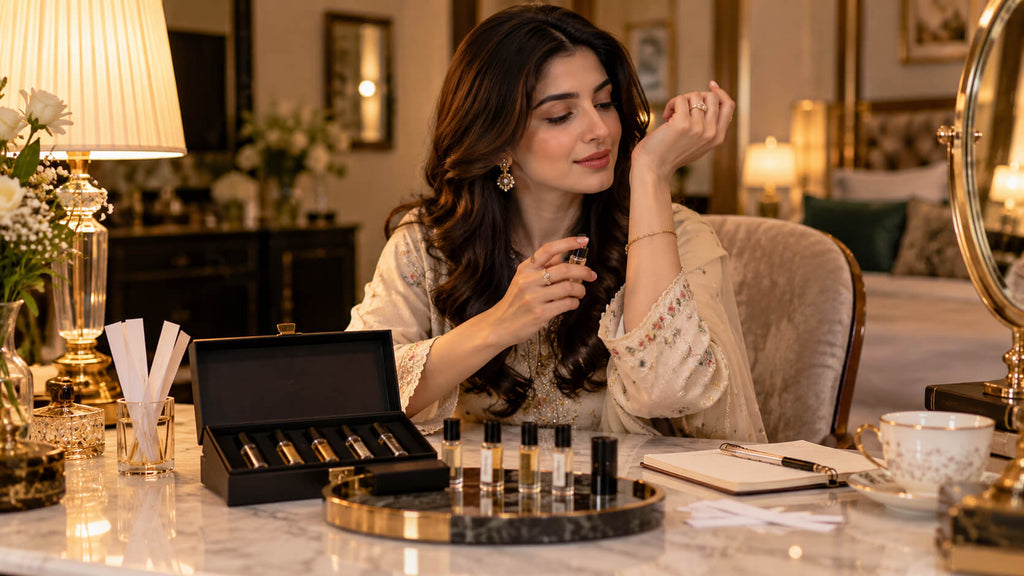
Label each vial clearly and choose three candidates for the first round. Read their note lists and write a prediction: fresh, floral, woody, creamy or spicy. Keep that prediction separate from what you actually smell later. Otherwise, a persuasive description can become your conclusion before you have tested anything.
If you use paper strips for an initial comparison, label them and keep them separate. Paper can help you reject a scent you strongly dislike, but it does not reproduce a normal day wearing perfume. Leave time between comparisons rather than smelling every vial repeatedly in one sitting.
Days 2 to 4: wear one candidate per day
Use one fragrance per test day, following the label's directions. Keep the application amount and placement as consistent as practical. Avoid another strongly scented product in the same area if your aim is to understand the sample on its own.
Record three impressions: shortly after application, around an hour later and later in your routine. These are observation points, not promised stages that every perfume follows on an exact clock. Note whether you enjoy the scent, whether it feels intrusive and whether you would choose to wear it again.
Day 5: compare your notes, not your memory
Read the records without immediately respraying. A dramatic opening can dominate memory even if you disliked the later scent. Give the settled fragrance enough weight in the decision. For a daily bottle, “comfortable and enjoyable for several ordinary activities” may be more valuable than “impressive in the first minute.”
Day 6: retest your leading choice
Wear the favourite again during a normal routine: commuting, working, studying or spending time at home. If the first test was entirely in an air-conditioned room, a second day that includes outdoor movement may reveal a different experience. Record the change instead of assuming the perfume has become inconsistent.
Day 7: decide whether to buy, wait or reject
Ask whether you like the dry-down, whether the scent fits your usual environment and whether the current full-bottle cost makes sense. “I need more time” is a useful outcome. Samples do their job even when they prevent a purchase rather than lead to one.
Use a simple comparison sheet
| Observation | What to record | Why it helps |
|---|---|---|
| Opening | Your own description, including anything you dislike | Separates first impression from advertising |
| Settled scent | What remains enjoyable or becomes too sweet, sharp or heavy | Helps judge the part you actually wear |
| Presence | Close to skin, noticeable nearby, or too much for the setting | Connects performance to your daily needs |
| Conditions | Indoors/outdoors, application amount, other scented products | Makes comparisons more fair |
| Purchase decision | Buy, retest, or skip, with one clear reason | Stops a discount from replacing preference |
You do not need a numerical scoring system. Plain notes such as “liked the opening, disliked the sweet finish” are often more actionable than giving every fragrance an eight out of ten. Record one concrete reason for each decision.
Testing fairly in Pakistani routines
A Karachi commute, an Islamabad office and an evening gathering are different wearing environments. Do not turn one city's name into a fixed fragrance rule. Test in the conditions you actually encounter, particularly if you move between outdoor warmth, shared transport and cooler indoor spaces.
For a practical explanation of note lists, read what perfume notes mean and how to read the label. Use those descriptions as clues, then allow your own test to confirm whether the fragrance appeals to you.
Ask a trusted person for feedback if you want to assess how noticeable a fragrance is nearby. Make clear that you want an honest observation, not a compliment. Your own reduced awareness after repeated exposure does not prove that the fragrance has disappeared.
Mistakes that make samples less useful
Testing many scents on the same skin area creates a mixed impression. Applying very different amounts makes a strength comparison unreliable. Judging immediately after spraying ignores the settled scent. Repeatedly sniffing the same spot can also make your own perception a poor guide to what someone else notices.
Do not assume a 3ml vial has a fixed number of usable days. Atomiser output and application habits vary. Use enough for sensible trials without expecting an exact spray count. If you empty every sample through rapid testing, you may have less opportunity to retest the one you actually prefer.
Read the exchange and return policy before ordering. A sample purchase is a way to gather information, not an assumption that every disliked or opened product can be returned. The current policy governs the order.
Questions about testing perfume samples
How long should I test a perfume before buying a bottle?
At least experience its settled scent and, where practical, wear your favourite on more than one day. The seven-day method is an organisational plan, not a scientific minimum. A known fragrance may need less evaluation than a completely unfamiliar style.
Are perfume samples the same strength as the full bottle?
Check that the sample is identified as the same fragrance and concentration. Do not assume equivalence across different versions or products with similar names. Atomisers and application amounts can also make the wearing experience feel different.
Should I test perfume on paper or skin?
Paper is useful for an initial comparison. A permitted skin application gives a more relevant picture of how you will wear it. Follow the label and avoid applying fragrance to irritated skin or areas where the directions do not allow use.
Can I test two perfumes at once?
Separate paper strips can support an initial comparison, but one fragrance per day gives a clearer wearing trial. Testing multiple scents close together makes it harder to identify which dry-down or scent trail you are noticing.
Let the sample guide the purchase
The best result is a clear decision based on your own wearing experience. Explore current sample choices at OPIO Fragrances, keep the shortlist manageable and retest the fragrance you enjoy most. A full bottle is easier to choose when you already know why you want to wear it.